How Do You Become a Flying Theater or 5D Cinema Distributor?
Distributor or agent, what a local partner needs (demo site, installers, power and permits know-how), the twelve clauses of a theater distributorship agreement, and how the first project usually works.
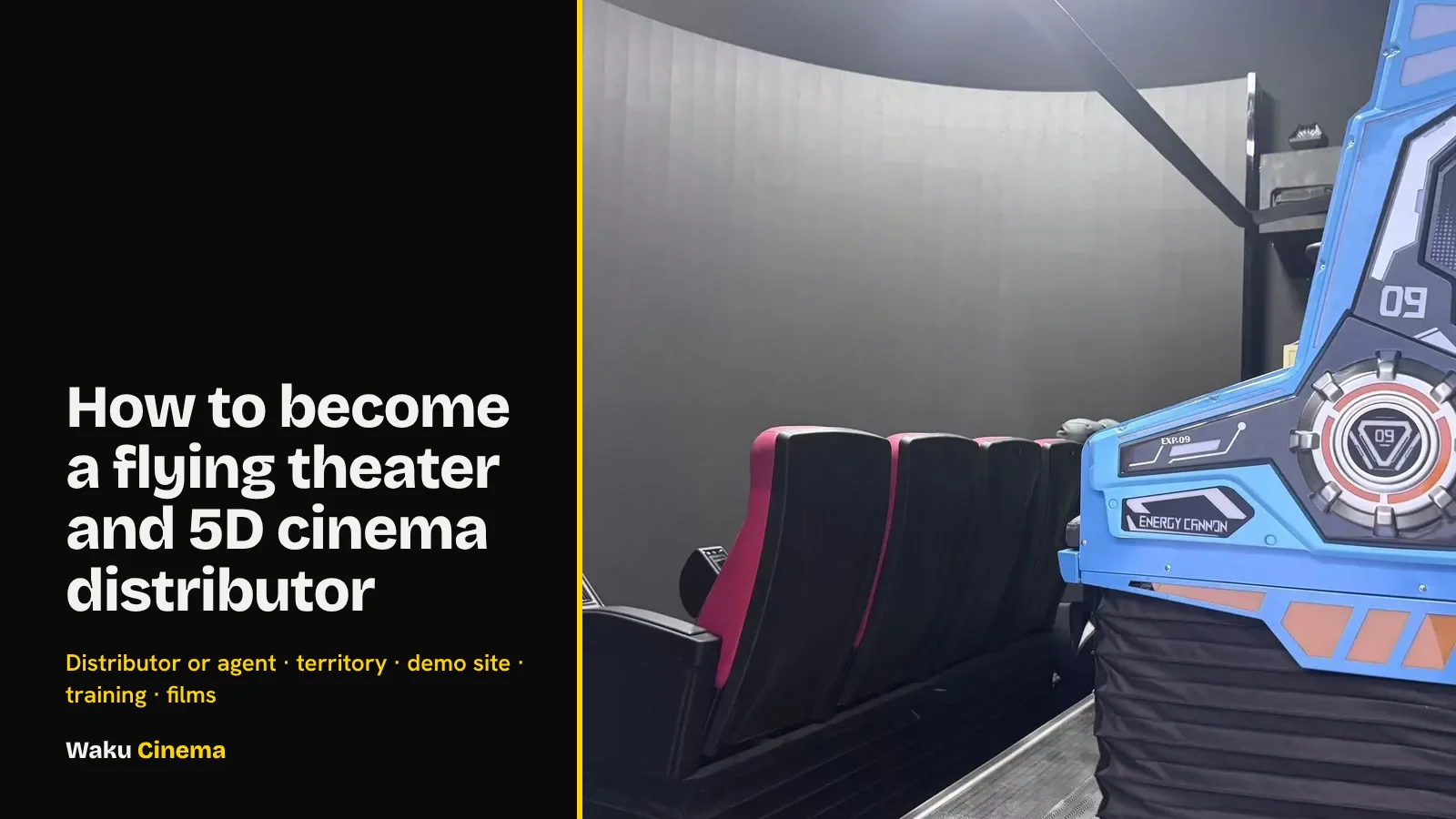
A flying theater or 5D cinema distributor buys theaters from the manufacturer and resells, installs and services them in a territory; an agent introduces venue owners and earns a commission while the manufacturer sells directly. To represent a theater maker you need venue contacts (malls, theme parks, museums, family entertainment centers), a technical team that can survey rooms and support installation, and a written agreement covering territory, exclusivity, targets, training, warranty handling and film rights.
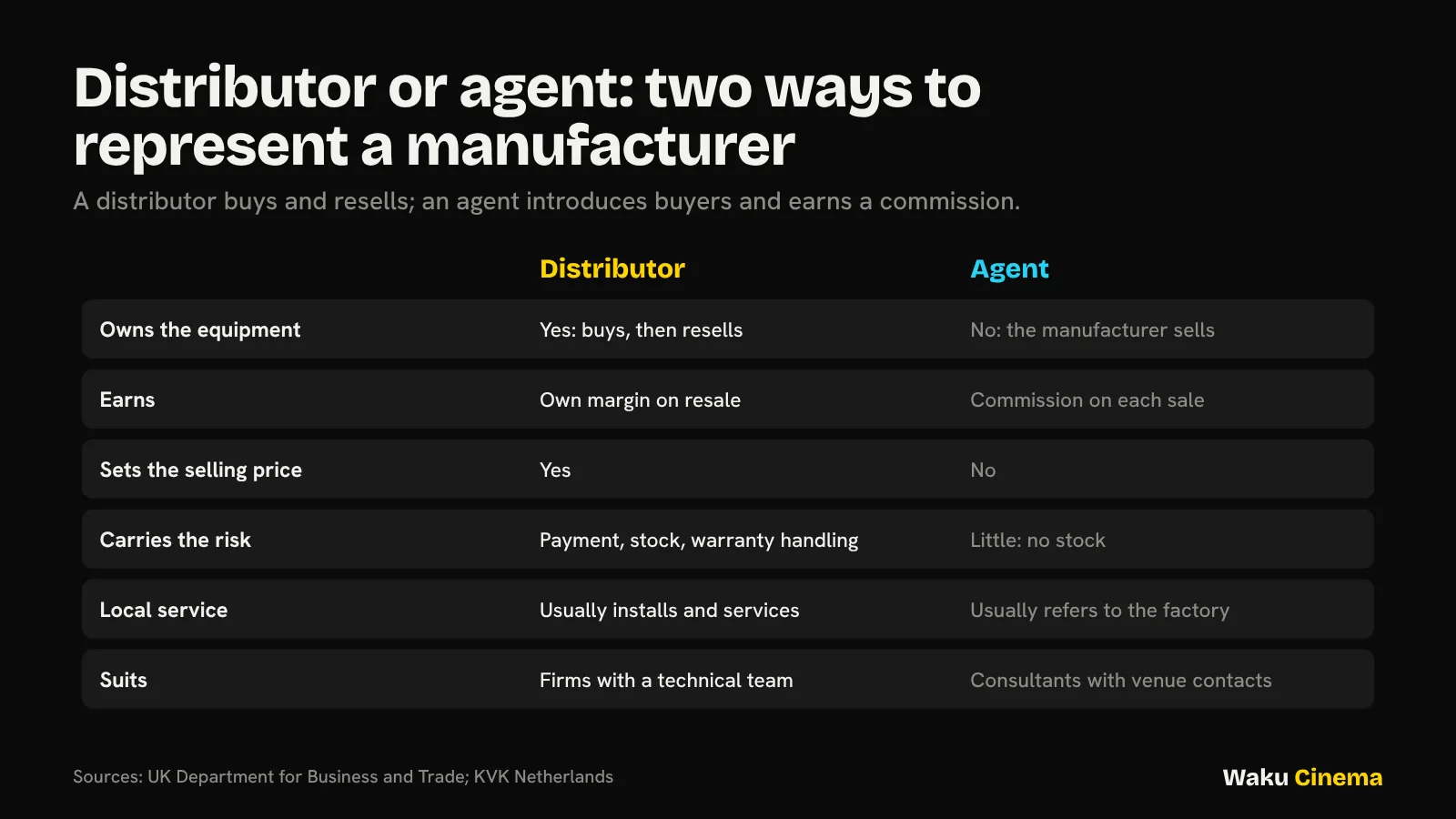
Distributor or agent: which model suits you?
| Distributor | Agent | |
|---|---|---|
| Owns the equipment | Yes: buys from the manufacturer and resells | No: the manufacturer sells and invoices the venue |
| Earns | Own margin on resale, plus installation and service work | A commission on each sale |
| Sets the selling price | Yes | No |
| Carries the risk | Customer payment, import, warranty handling | Little: no stock, no import |
| Local service | Usually surveys, installs and services | Usually refers technical work to the factory |
| Suits | Attraction installers, AV and cinema contractors, amusement equipment importers | Consultants and developers with venue contacts |
This is the general split described in export guidance from the UK Department for Business and Trade and the Netherlands Chamber of Commerce (KVK): a distributor takes title to the goods and resells them at its own risk; an agent works on the manufacturer’s behalf for a commission. Many theater partners start as agents on the first project and move to distribution once they have a team and a reference site.
What does a theater distributor need locally?
- Venue contacts: shopping mall leasing teams, theme park and water park operators, science museums, scenic areas and family entertainment center chains.
- A technical team: people who can measure a room, read a layout drawing, check a 380 V three-phase supply and work alongside the manufacturer’s engineers during installation.
- Knowledge of local approvals: which authority licenses attractions, which safety standard its inspector uses (ASTM F2291 or EN 13814 in many markets) and what the fire and building rules require for a seated audience.
- A way to show the ride: a reference site you can take buyers to, or a small demo unit. Buyers of a flying theater want to ride before they sign.
- After-sales capacity: someone who answers the venue’s calls and handles routine service; for Waku theaters that means daily checks, consumables and greasing the motion platform every 2 to 3 months.
What should a theater distributorship agreement cover?
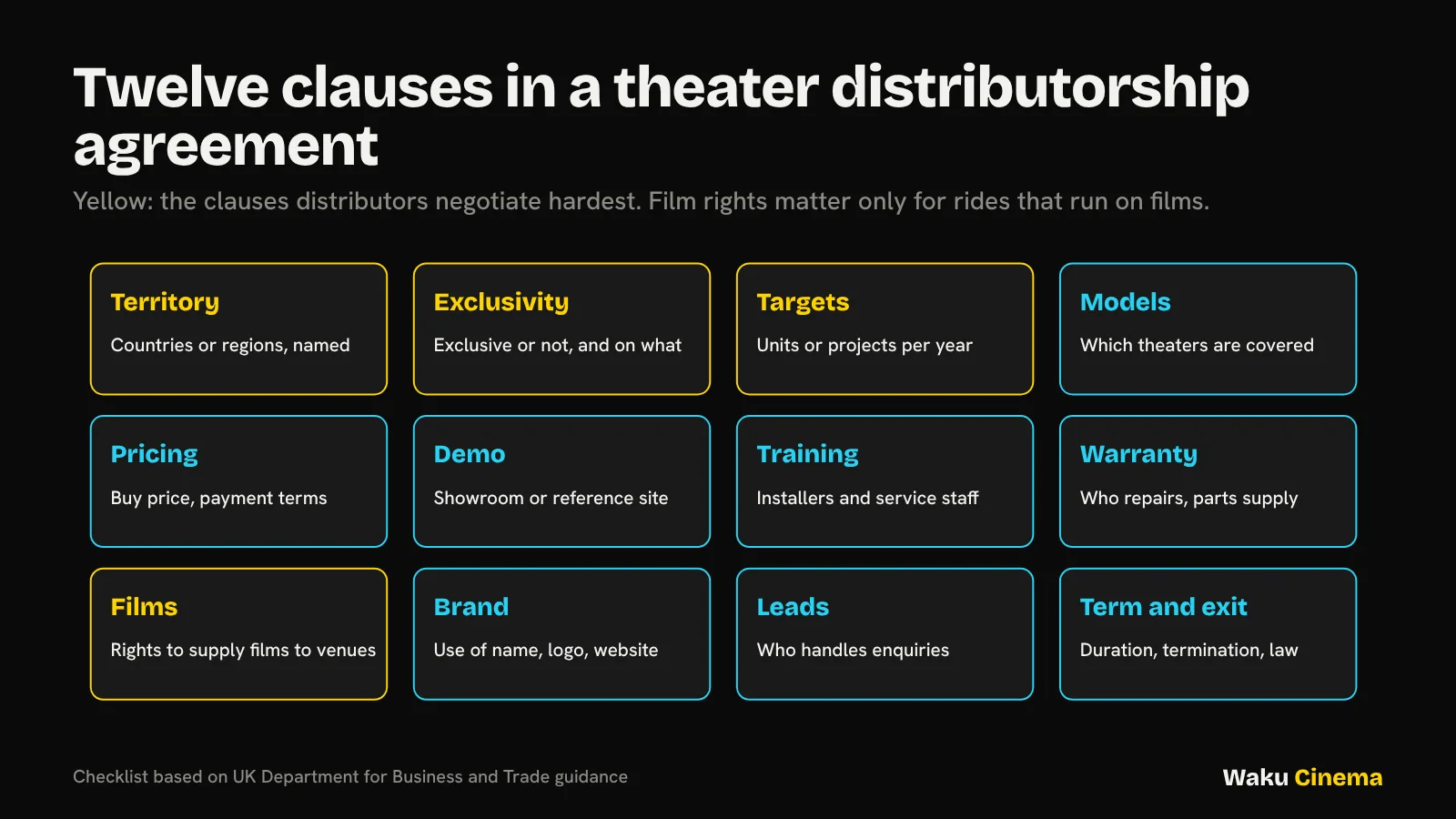
| Clause | What to agree | Why it matters for theaters |
|---|---|---|
| Territory | Countries or regions, named | Projects are few and large; overlap causes disputes |
| Exclusivity | Exclusive or not, and for which models | Exclusivity is usually tied to targets |
| Targets | Projects or theaters per year | Counted in projects, not units |
| Models | Which theaters the partner may sell | Dome, 5D, track and motion theaters need different skills |
| Pricing and payment | Partner price or commission, payment terms | Sets the partner’s margin and cash flow |
| Demo and reference | Showroom unit or reference site | Buyers want to ride before they sign |
| Training | Installation and service training | Who can install without factory engineers |
| Warranty and parts | Who repairs, response time, spare parts | The venue calls the local partner first |
| Films | Right to supply and update films for venues | Theaters earn from new films; film rights stay with the maker |
| Brand and marketing | Use of name, logo, photos, website | Avoids copies of the manufacturer’s site |
| Leads | Who handles enquiries from the territory | Direct enquiries passed to the partner, or not |
| Term and exit | Duration, termination, governing law | Venues still need service after the agreement ends |
Agency agreements also need the commission rate and when it is paid. In the European Union, commercial agents have statutory rights, including compensation or indemnity when an agreement ends, so take local legal advice before signing either kind of agreement.
How does the first project usually work?
- You bring a venue: room size, clear height, power and the owner’s target guests per show.
- The manufacturer proposes the model and seat count and draws the layout; you present it with your local costs (site works, import, installation support).
- The theater is built and tested in the factory. Waku production takes 20 to 25 days.
- Your team installs alongside the factory engineers, so the second project can be done with less factory support.
- The first site becomes your reference site for the next buyers.
How do you start with Waku?
Waku makes the dome flying theater, the 5D flying theater, the track cinema and the Bermuda Adventure in its own factory in Guangzhou, together with the films and the show-control software. Send us your company profile, your territory, the venues you work with and whether you have an installation team; we discuss the partnership model and terms for your market and arrange a factory visit or video tour. For the buying side of the same process, see our import guide and our ten questions to ask a manufacturer.
Frequently asked questions
What is the difference between a distributor and an agent?
A distributor buys the theater from the manufacturer and resells it at its own price and risk; an agent introduces buyers and earns a commission while the manufacturer sells and invoices directly.
Do I need a technical team to distribute flying theaters?
For distribution, yes: someone must survey rooms, check the 380 V supply, support installation and handle routine service. An agent can rely on the factory for technical work.
Can a distributor get exclusive rights?
Exclusivity is a clause in the agreement, usually tied to a territory, the models covered and yearly targets.
Who supplies films to the venues?
Film rights stay with the manufacturer. The agreement should say whether the partner may supply and update films for venues in the territory.
How do I apply to represent Waku?
Send your company profile, territory, the venues you work with and your installation capacity. We discuss the partnership model and terms for your market.
Talk to the factory
Tell us your country, venue size and ceiling height. We reply with a recommendation and a quotation.