How Much Ticket Revenue Can a Flying Theater Make per Month?
Monthly ticket revenue = seats × shows per hour × opening hours × ticket price × days × occupancy. Capacity tables for every Waku model and how occupancy changes the result.
Monthly ticket revenue = seats × shows per hour × opening hours × ticket price × opening days × average occupancy. Seats and shows per hour are set by the theater; ticket price, hours and occupancy are set by your site. A 30-seat 5D flying theater on a 12-minute cycle sells up to 150 tickets an hour, so at US$10 a ticket and 40% average occupancy over 10 hours a day it takes US$6,000 a day, or US$180,000 in a 30-day month.
How do I calculate monthly ticket revenue?
Work through five inputs in order:
- Seats per show: fixed by the model and version you buy.
- Shows per hour: 60 ÷ cycle time in minutes. The cycle is the film plus unloading and boarding.
- Opening hours per day and opening days per month.
- Ticket price in your currency.
- Average occupancy: the share of seats sold across all shows, weekdays and weekends together.
Revenue per month = seats × shows per hour × hours × days × occupancy × ticket price.
How many shows per hour can each model run?
The cycle is the film length plus the minutes your staff need to unload and board the seats. The table uses the longest film of each model and two boarding times; shows per hour are rounded down to whole shows.
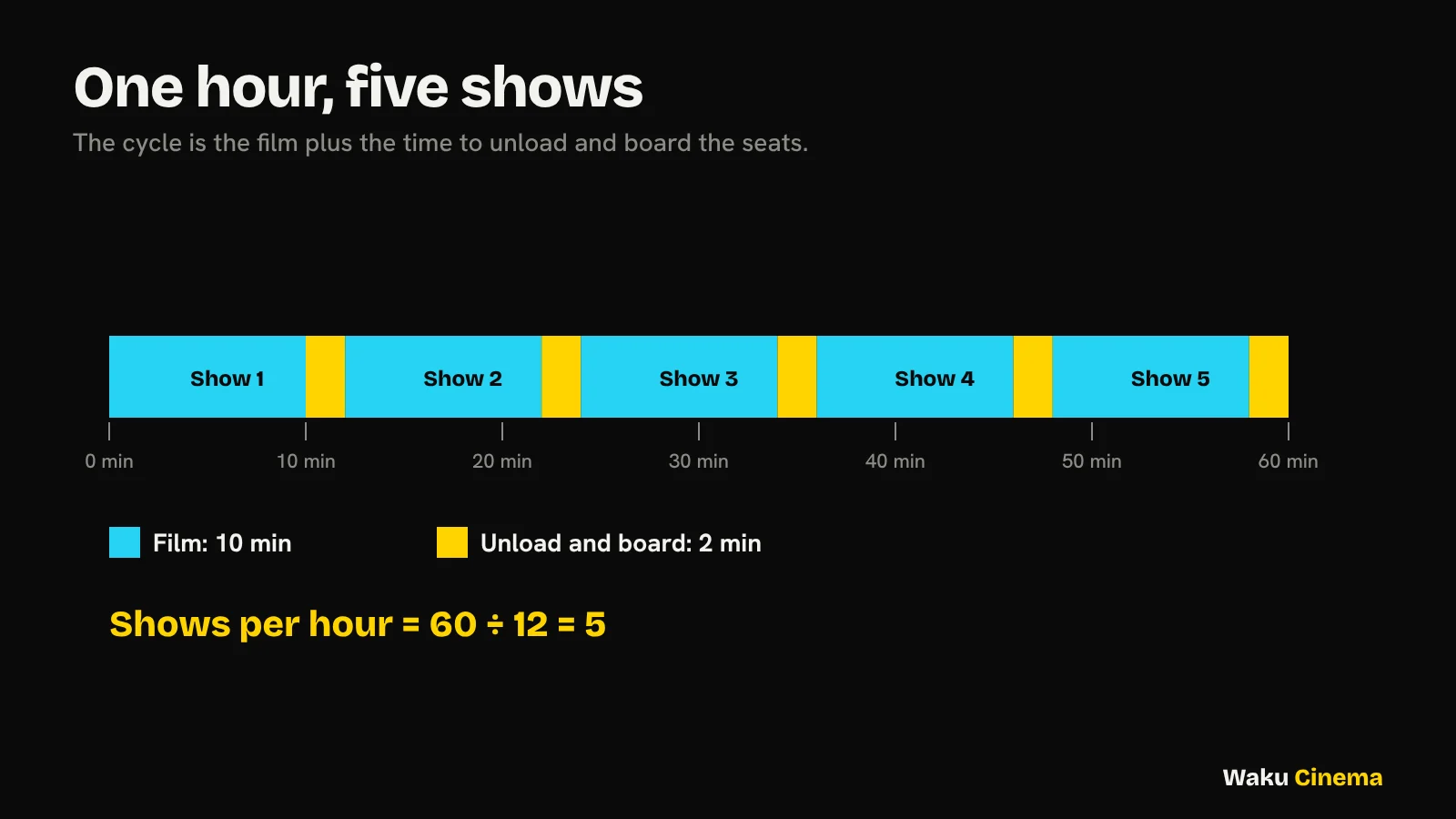
| Model | Film length | Boarding 2 min | Boarding 5 min |
|---|---|---|---|
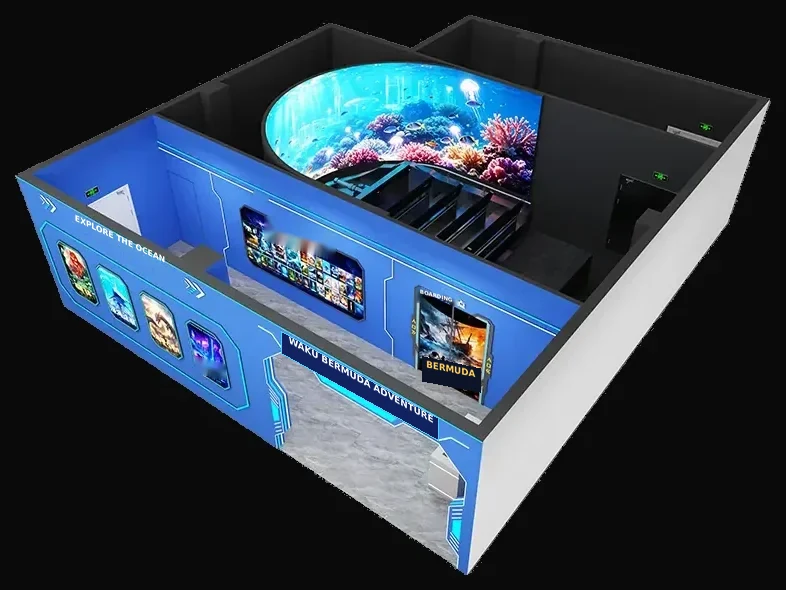
| Bermuda Adventure | 5–8 min | 8 + 2 = 10 min → 6 shows/h | 8 + 5 = 13 min → 4 shows/h |
| 5D flying theater | 5–10 min | 10 + 2 = 12 min → 5 shows/h | 10 + 5 = 15 min → 4 shows/h |
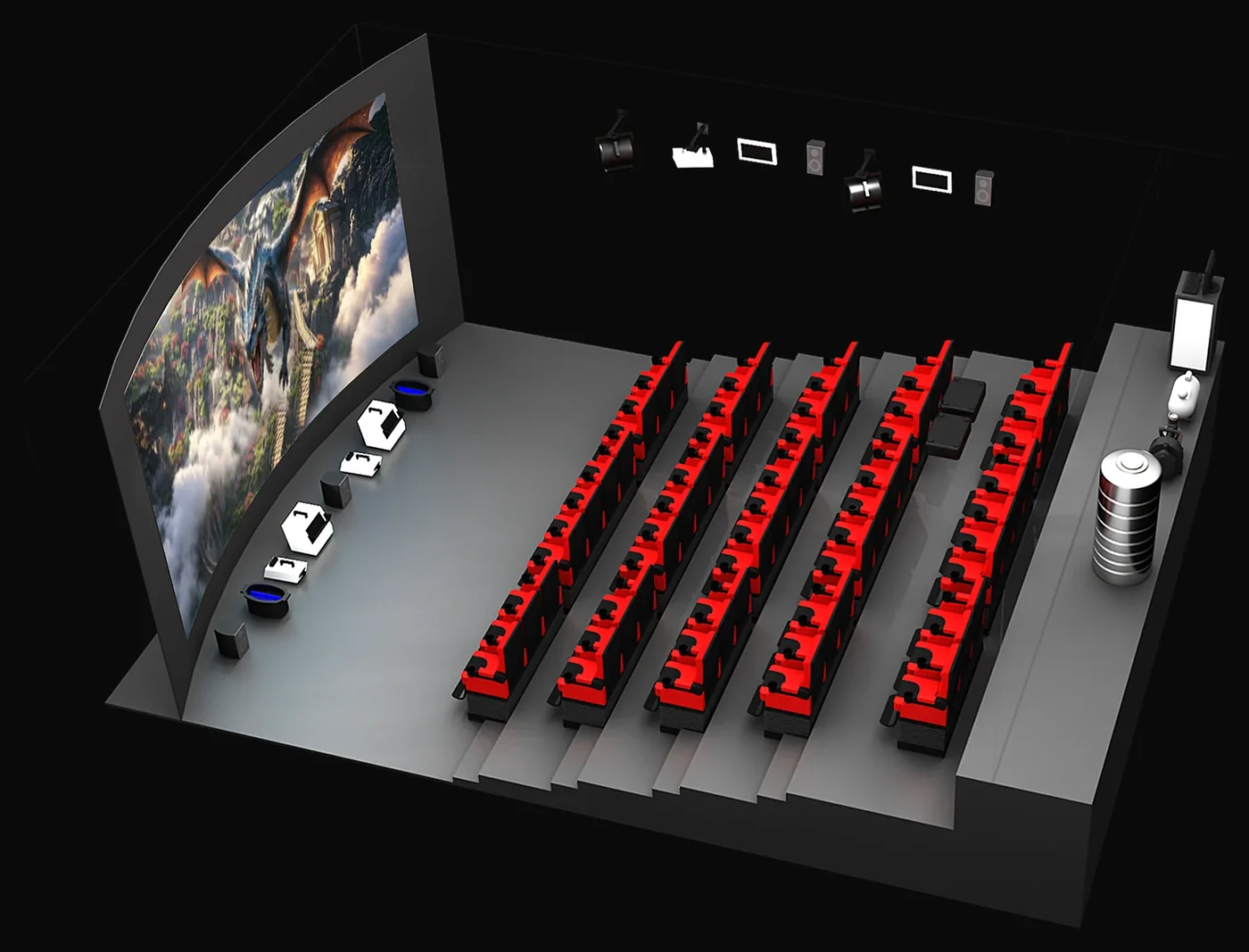
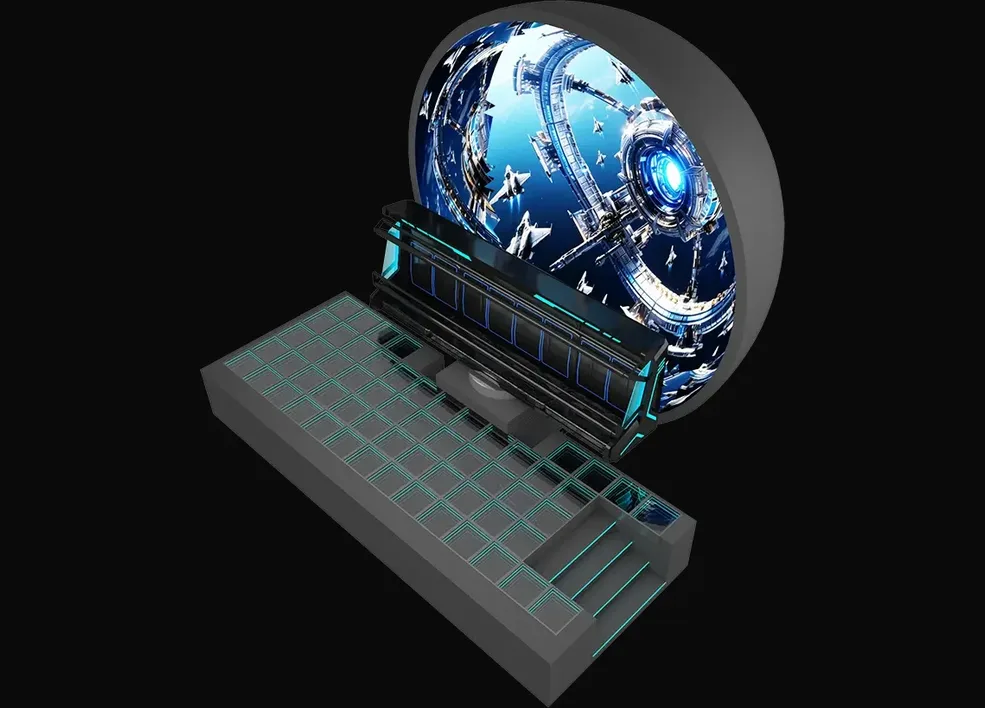
| Dome flying theater | 8–10 min | 10 + 2 = 12 min → 5 shows/h | 10 + 5 = 15 min → 4 shows/h |
| Track cinema | 8–10 min | 10 + 2 = 12 min → 5 shows/h | 10 + 5 = 15 min → 4 shows/h |
Shorter films raise the count: a 5-minute film with 2 minutes of boarding is a 7-minute cycle, or 8 shows per hour. Time your own unloading and boarding during the trial runs and use that cycle in the calculation.
What is each model worth per hour at full occupancy?
The table uses the same 12-minute cycle (5 shows per hour) for every model so the versions compare directly, and a ticket price of US$10.
| Model and version | Seats | Tickets per hour | Revenue per hour |
|---|---|---|---|
| 5D flying theater | 10 / 16 / 30 / 60 | 50 / 80 / 150 / 300 | US$500 / 800 / 1,500 / 3,000 |
| Bermuda Adventure | 15 / 20 / 30 | 75 / 100 / 150 | US$750 / 1,000 / 1,500 |
| Dome flying theater | 8 / 16 / 24 / 32 | 40 / 80 / 120 / 160 | US$400 / 800 / 1,200 / 1,600 |
| Track cinema | 10 / 15 | 50 / 75 | US$500 / 750 |
To use another ticket price, multiply the tickets per hour by your price.
How much does occupancy change the result?
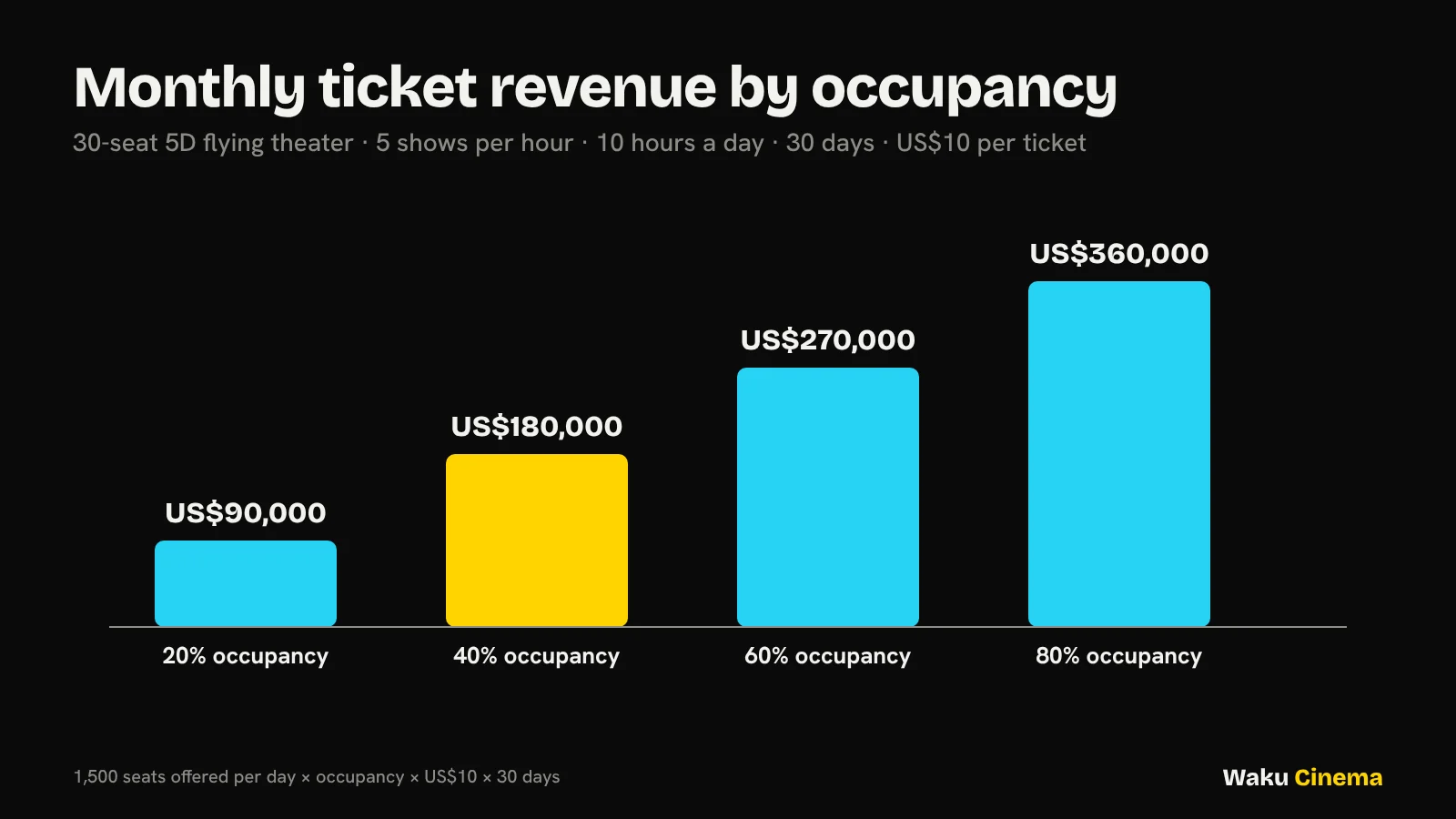
Occupancy moves the result more than any other input, because weekday traffic is usually much lower than weekend traffic. The table shows a 30-seat 5D flying theater, 5 shows per hour, 10 hours a day, 30 days a month, US$10 per ticket: 1,500 seats are offered each day.
| Average occupancy | Tickets per day | Revenue per day | Revenue per 30-day month |
|---|---|---|---|
| 20% | 300 | US$3,000 | US$90,000 |
| 40% | 600 | US$6,000 | US$180,000 |
| 60% | 900 | US$9,000 | US$270,000 |
| 80% | 1,200 | US$12,000 | US$360,000 |
Weekends and weekdays usually fill differently, so calculate them separately and add them. With 8 weekend days at 90% occupancy and 22 weekdays at 25%, the same theater sells 8 × 1,500 × 90% = 10,800 weekend tickets and 22 × 1,500 × 25% = 8,250 weekday tickets: 19,050 tickets, or US$190,500 a month at US$10.
Which costs come out of ticket revenue?
- Rent or revenue share with the venue.
- Staff: one operator can start the show from the control system; add ticketing and queue staff for your traffic.
- Electricity: energy = power × hours × tariff. Rated power is the maximum draw, so it gives an upper limit. A 20-seat Bermuda Adventure at about 16 kW over 10 hours uses at most 160 kWh a day; at US$0.15 per kWh that is at most US$24 a day.
- Consumables: bubble fluid and snow fluid for the effects system.
- Maintenance: greasing the motion platform joints and tightening its bolts every 2 to 3 months, done by trained staff.
- Films: film updates are free, and the dome flying theater ships with 30 films, so there is no per-title fee to budget.
- Taxes in your country.
How do I test the numbers for my own site?
Each theater page has a revenue estimator with these inputs: the 5D flying theater, the dome flying theater, the track cinema and the Bermuda Adventure. Enter your own ticket price, hours and occupancy, then send us the result with your floor plan and we will recommend the version that matches your traffic.
The cost side of the same calculation is covered in how much a flying theater or 5D cinema costs. If you are choosing attractions for a whole venue, see flying theaters in family entertainment centers.
Frequently asked questions
What ticket price should I use?
Use what visitors near your site already pay for comparable attractions. The tables use US$10 so the arithmetic is easy to scale: multiply tickets per hour by your own price.
How many shows per hour can I run?
Divide 60 by your cycle time in minutes. A 10-minute cycle gives 6 shows per hour, 12 minutes gives 5 and 15 minutes gives 4.
Do films cost extra after purchase?
No. Film updates are free, and the dome flying theater ships with 30 films.
How much electricity does a theater use?
At most its rated power multiplied by the opening hours. A 20-seat Bermuda Adventure at about 16 kW uses no more than about 160 kWh in a 10-hour day.
How soon can the theater start earning?
Production takes 20 to 25 days from order, followed by shipping to your port and installation on site.
Talk to the factory
Tell us your country, venue size and ceiling height. We reply with a recommendation and a quotation.