How Does a Dome Flying Theater Work?
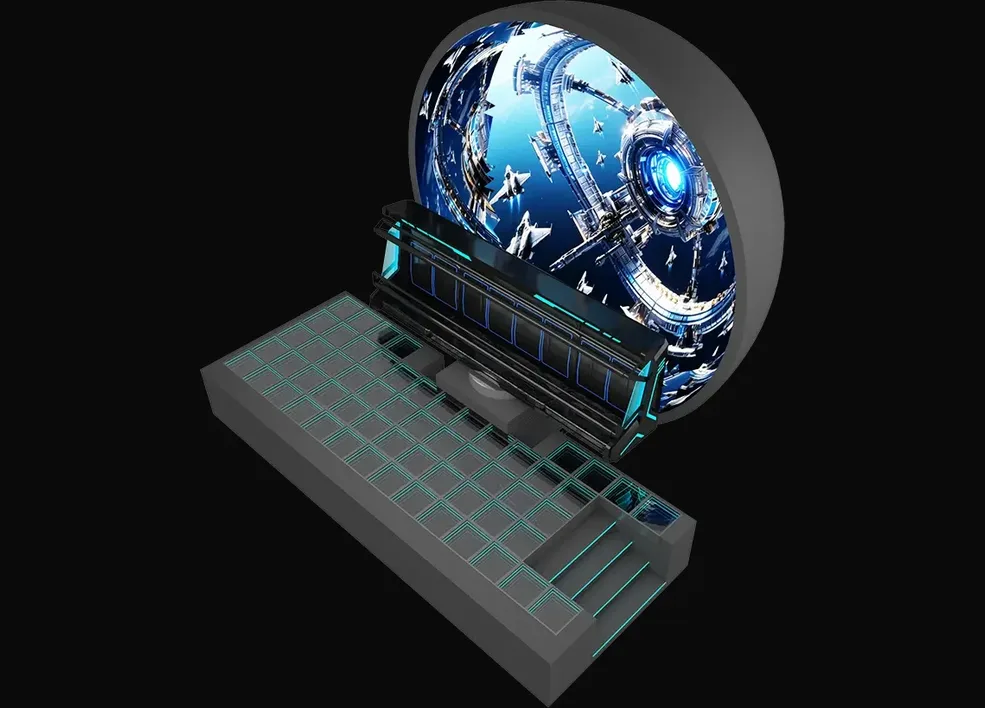
Guests sit on a suspended row of motion seats in front of a hemispherical screen that fills their field of view. How the dome, projection, seats and effects work together, and what size of room each needs.
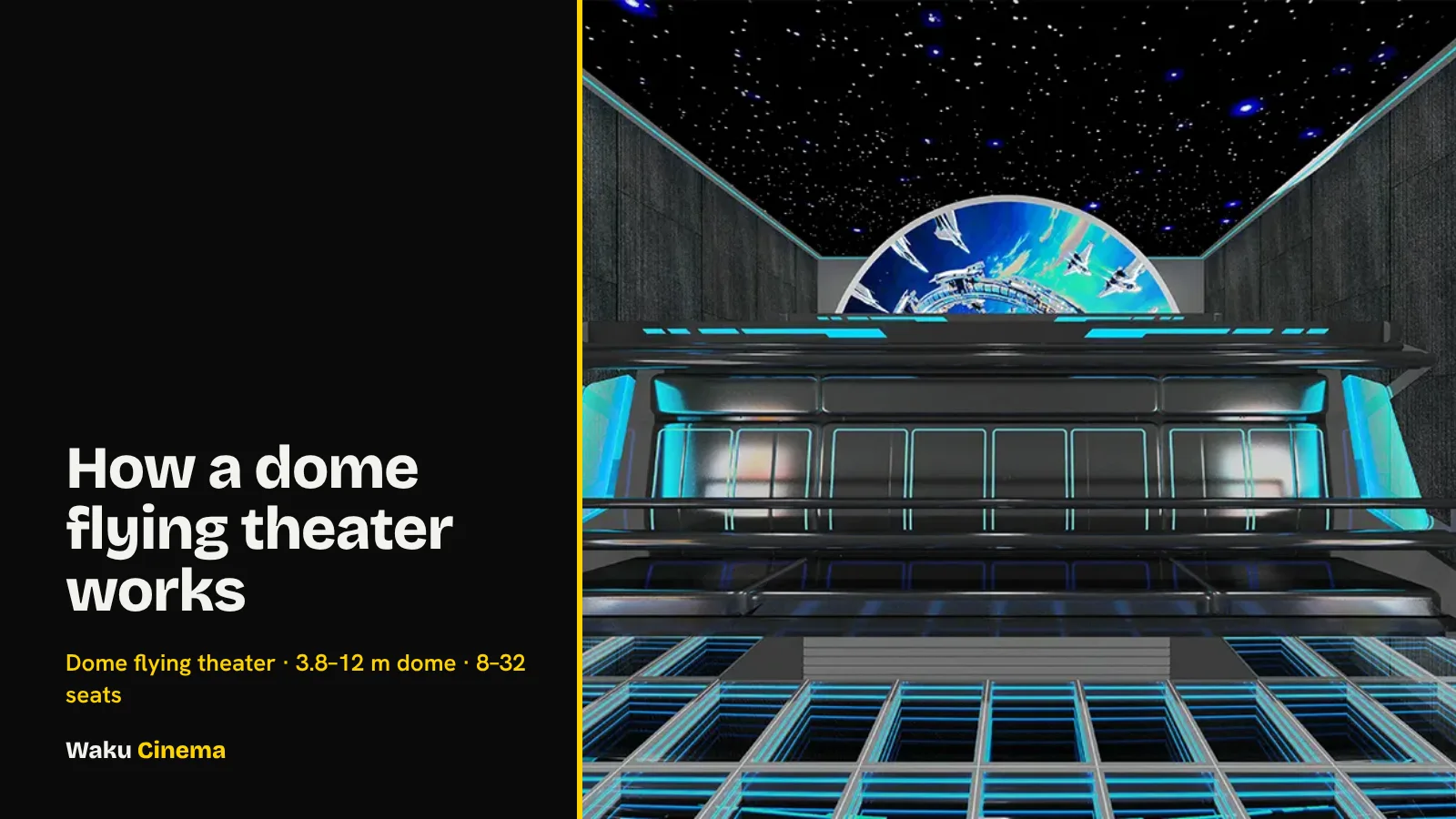
A dome flying theater makes guests feel they are flying by combining three systems: a hemispherical screen that fills their whole field of view, a suspended row of motion seats that tilts and lifts in step with the film, and an effects system that adds wind, rain and snow at the right moment. Waku builds it with domes of 3.8, 5, 6 or 12 m in diameter and 8, 16, 24 or 32 seats; the smallest version needs a room of 6 × 6 m with 3.8 m of clear height.
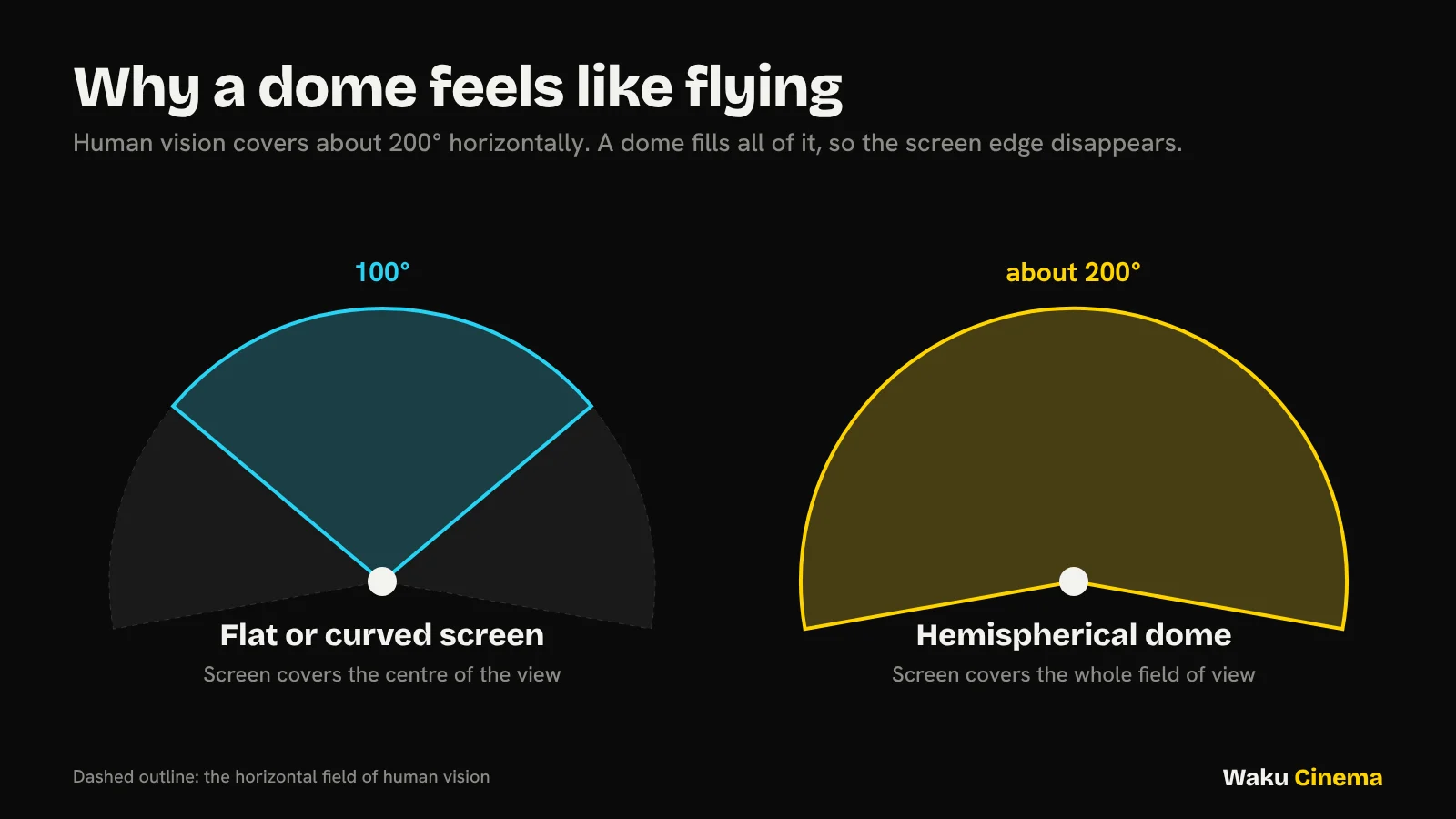
Why does a dome screen feel more like flying than a flat screen?
Human vision covers roughly 200° horizontally and about 130° vertically. A flat or curved screen fills only the centre of that field, so the eye still sees the room around it. A hemisphere wraps above, below and to both sides of the guest, so the frame of the screen disappears and the brain accepts the image as the world outside. That is why the same aerial film feels like a view on a flat screen and like flight in a dome.
| Question | Flat or curved screen | Hemispherical dome |
|---|---|---|
| How much of the view does it fill? | The centre; the room edges stay visible | Above, below and both sides of the guest |
| Is the screen edge visible? | Yes | No, from the seats |
| Clear room height needed | From 3 m (Waku 5D flying theater) | From 3.8 m (smallest Waku dome) |
| Waku model | 5D flying theater (180° curved) | Dome flying theater |
What is a dome theater, and how is a dome flying theater different?
A dome theater, or dome cinema, projects a film onto the inside of a hemispherical screen, as in a planetarium or an IMAX Dome theater in a science centre. Guests sit in fixed, tilted seats and look up into the dome. A dome flying theater uses the same kind of screen but lifts guests on motion seats, so they feel the flight as well as seeing it; it is a ride rather than a cinema.
What is a 360 dome theatre, and is fulldome the same as IMAX Dome?
“360 dome theatre” and “fulldome” describe the same idea: the image fills the whole inside of a hemispherical dome, 360 degrees around and up to the zenith, as in a modern digital planetarium. IMAX Dome, earlier called OMNIMAX, is a branded giant-screen film system in a tilted dome; its film image did not cover the full hemisphere, and the seating hides the uncovered part from most viewers.
A Waku dome flying theater uses fulldome projection: laser projectors blend into one continuous image across the dome, and the seat row is lifted toward its centre, so the dome fills each guest’s view in every direction.
What are the main parts of a dome flying theater?
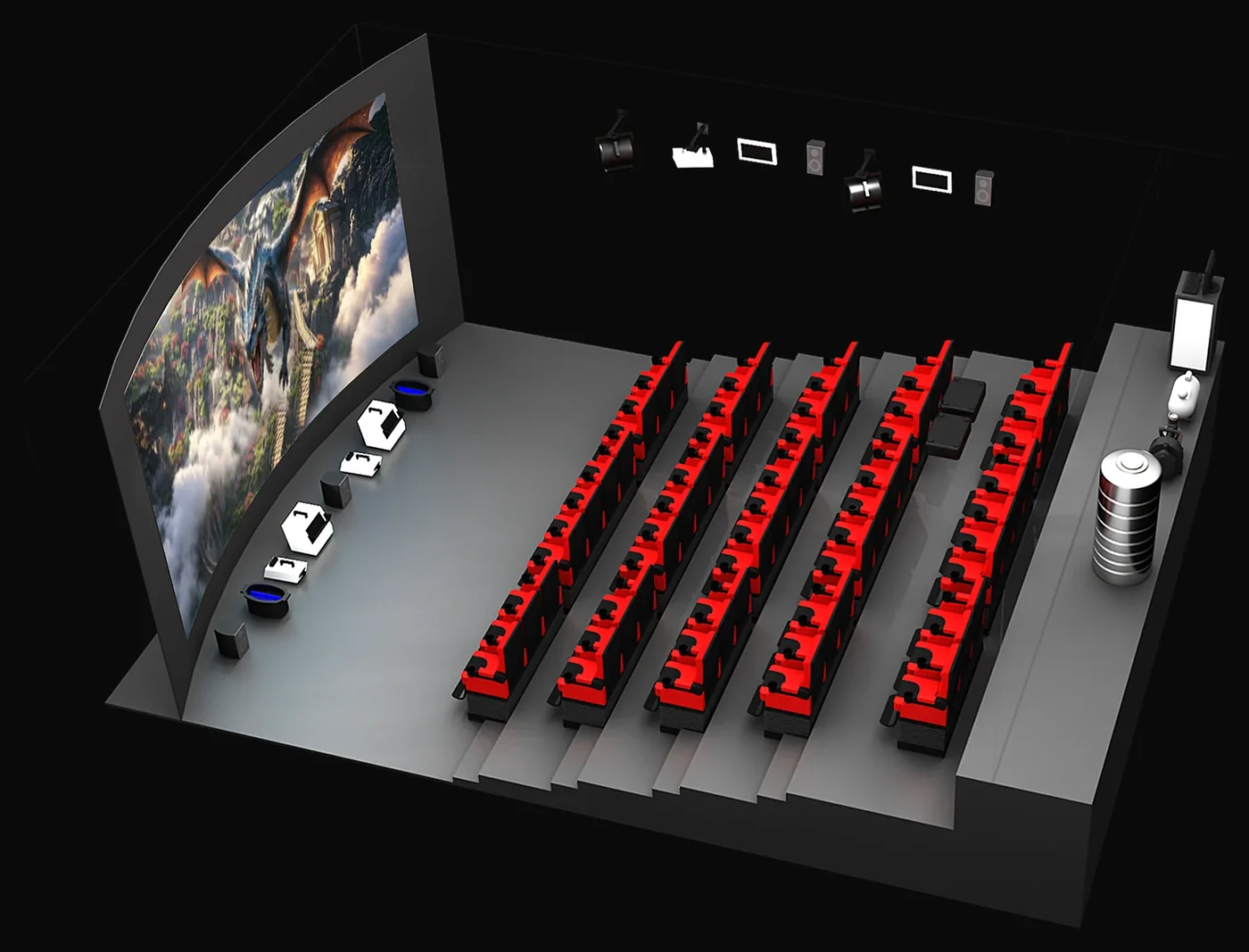
| Part | What it does | Waku specification |
|---|---|---|
| Dome screen | Carries the image over the whole field of view | 3.8, 5, 6 or 12 m diameter; fibreglass (FRP) or perforated aluminium |
| Projection | Covers the dome with one continuous image | 4K laser projectors |
| Motion seats | A suspended row moves with the camera path of the film | 8, 16, 24 or 32 seats; seat surface stays within 1.95 m of the base, under 2 m/s |
| Effects system | Adds physical cues on the film’s timeline | Wind, rain, snow, mist, smoke and bubbles |
| Sound | Places sound around the guests | Surround speaker system |
| Control | Starts film, motion and effects together | One-key start from a tablet |
Should I choose a fibreglass or a perforated aluminium dome?
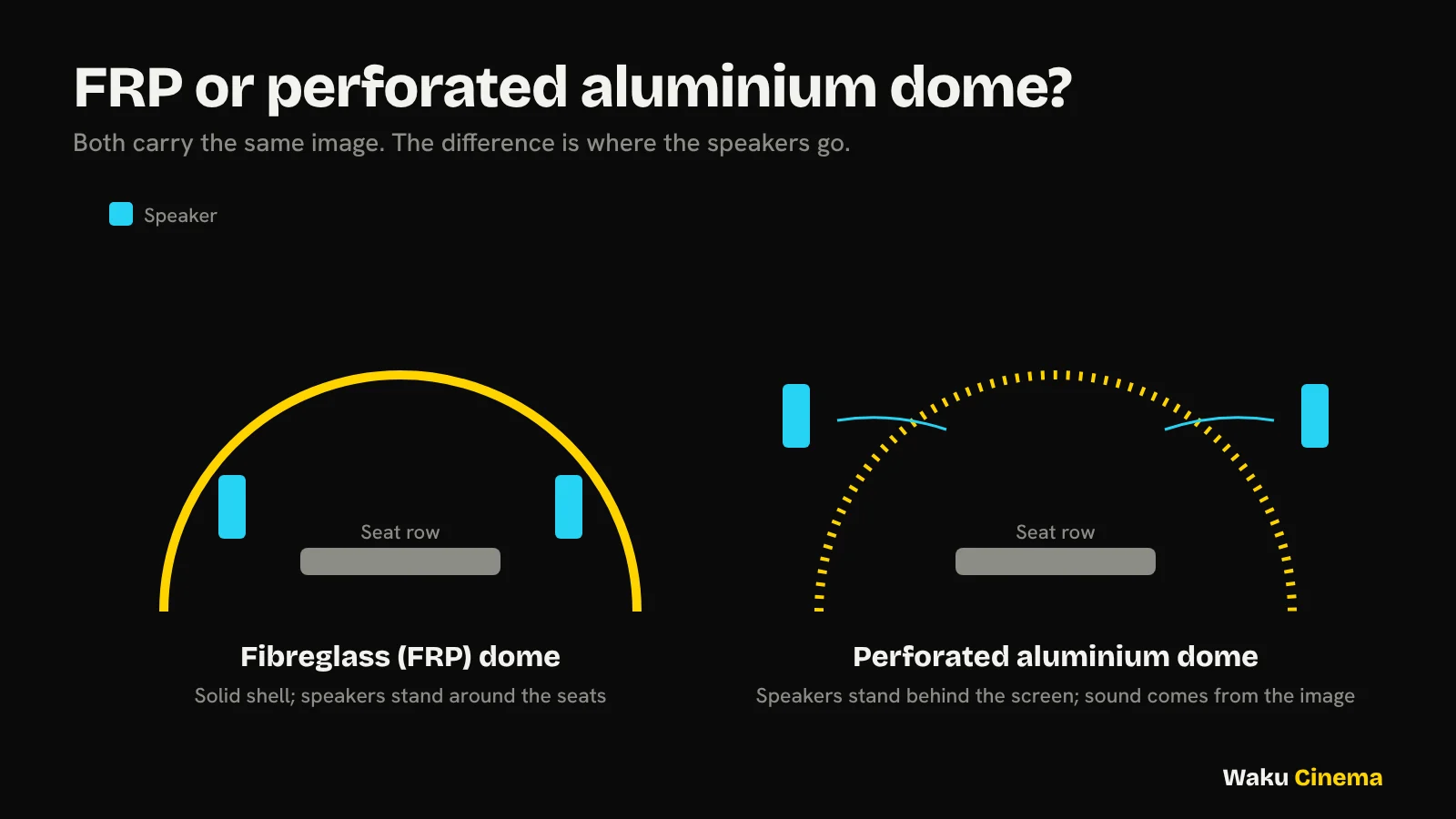
Both carry the same projected image; the difference is sound and building work. A perforated aluminium dome is acoustically transparent, so speakers can stand behind the screen and the sound comes from the picture itself. A fibreglass (FRP) shell is solid, so speakers sit around the seating area. Choose perforated aluminium when you want sound to come from the image, and FRP when you want a self-contained shell that is simple to install.
What size dome and room do I need?
Start from your clear ceiling height. The smallest Waku dome, 3.8 m in diameter, fits a room of 6 × 6 m with 3.8 m of clear height. The 5, 6 and 12 m domes need proportionally taller rooms and are planned around the building, which is why the 12 m dome usually suits museums, visitor centres and purpose-built halls.
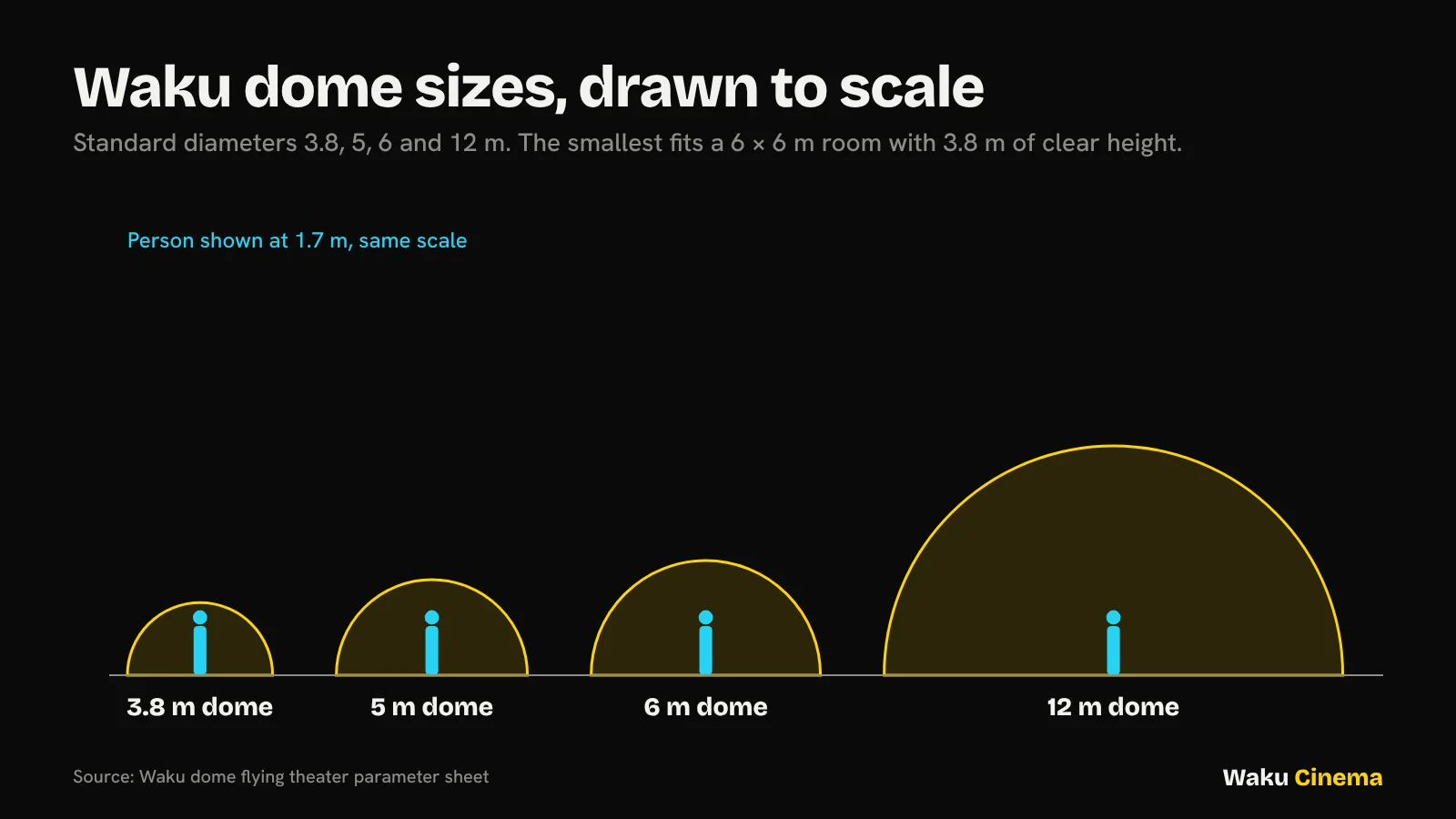
| Item | Options |
|---|---|
| Dome diameter | 3.8, 5, 6 or 12 m; other sizes on request |
| Seats | 8, 16, 24 or 32 |
| Minimum room (L × W × H) | 6 × 6 × 3.8 m |
| Film length | 8–10 minutes |
| Power supply | 380 V, about 20–60 kW, by configuration |
| Films included | 30 films; updates are free |
If your ceiling is under 3.8 m, compare the 5D flying theater (from 3 m) and the track cinema (from 3.2 m) in our guide to choosing a flying theater.
Where does a dome flying theater work best?
Science and technology museums, history museums, theme parks, scenic areas and cultural tourism towns. The full-view dome suits landscape, space and educational films, and a large dome can serve as the landmark attraction of a site.
How do I get a layout for my site?
Send your floor plan, clear ceiling height, local voltage and target seat count. We reply with the dome size, seat count, a layout drawing and a quotation. Send your venue details or see the full dome flying theater specifications.
For dome diameter, screen material and projector layout, read how to plan a dome theater. For the wider category, see what a flying theater is.
Frequently asked questions
What is the smallest room for a dome flying theater?
6 × 6 m with 3.8 m of clear height, for the 3.8 m dome.
How many guests ride at once?
8, 16, 24 or 32, depending on the version.
Do guests need 3D glasses?
No. The dome gives a glasses-free 3D effect.
Can the dome be larger than 12 m?
Standard domes are 3.8, 5, 6 and 12 m; other sizes are made on request to fit the building.
How many films are included?
The dome flying theater ships with 30 films, and film updates are free.
Talk to the factory
Tell us your country, venue size and ceiling height. We reply with a recommendation and a quotation.